The TASK XXIV
Welcome to the TASK XXIV On the role of Process and Energy System Integration for the Industry Decarbonisation of the Industrial Energy-Related Technologies and Systems the Technology Collaboration Programme of the International Energy Agency. IETS TCP Task XXIV by IEA
This is a networking activity with the aim for the task partner to share models in the prespective of the industry decarbonisation.
Coordination
The task XXIV is corodinated by Prof François Marechal and his team in École Polytechnique Fédérale de Lausanne (EPFL)
Address: Rue de L’Industrie 17, Sion, 1951, Valais/Wallis, Switzerland
Institution Contact: Dr. Daniel Florez Orrego
Goals and task Organisation
Context
Due to a limited access to technical information on energy and decarbonization technologies and techniques, along with a lack of financial resources to conduct energy audits and process inte-gration analyses, many industries are unaware of the improvement potential of their processes. This fact hinders the evaluation of decarbonization roadmaps, overlooking the energy saving potentials and delaying the energy transition. On the other hand, the results of collaborative projects between academia and industry are generally presented as poorly documented static data in journals and reports, which makes them difficult to compare and reproduce, impairing the knowledge transfer and validation of the developed models.
The motivation of the Task XXIV “Process Integration for Industry Decarbonization” of the Tech-nology Collaboration Program (TCP) of the Industrial Energy-related Technologies and Systems (IETS) is to tackle these challenges by driving the international collaboration for creating, docu-menting and maintaining an open-source database of industrial processes and energy technolo-gy models and methods, that capitalizes on the experiences of researchers and industries. Con-fidentiality and validation of the models developed with industrial partners must be transparently addressed, so as to protect sensible information, while fostering industrial symbiosis and offering first-hand information about decarbonization roadmaps to similar sectors.
This project is related to the current research priorities (i) Process integration and use of waste heat, (ii) Decarbonization of industrial value chains, and (iii) Renewable energy in industrial processes of the Research program for the indus-trial processes.
Objectives
The main objectives of the Task XXIV are to: (details on https://iea-industry.org/tasks/process-integration-for-industry-decarbonization/)
- Develop specifications and procedures for generating, validating, and sharing process and energy integration models.
- Share flexible ex-ante (blueprint) models of key industrial sectors.
- Share energy technology models to promote renewable energy use in industry.
- Share energy systems models, including distribution networks and seasonal demand data.
- Compare and document process integration methods used by the participants for assessing the decarbonization pathways in industry.
- Compare heat and mass integration results to outline roadmaps of industrial decarbonization and symbiosis.
- Share findings and experiences through workshops, scientific events, and educational pro-grams.
To reach those goals we will develop the specifications and procedures for creating, validating, and sharing process and energy technology integration models for key industrial sectors and develop Open-access database of key industrial processes and energy technology models featuring performance indicators. Detailed description of their potential for advancing the industrial decarbonization.
We will compare and document process integration methods and tools used by Task participants to assess decarbonization pathways in industry and generate a documented list of the available open-source tools and methods for analyzing industrial process integration and decar-bonization pathways.
Netowking is the main activity of the TASK XXIV with the aim of share findings and experiences through workshops, scientific events, and educational programs Dissemination in conferences, IETS work-shops, bi-annual, annual and final reports, and continuing education program (Master of Advanced Studies of EPFL).
Organisation
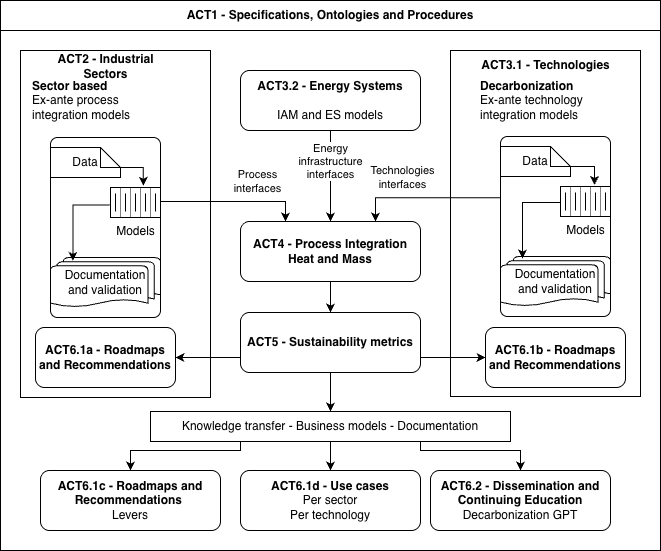
Activity 1: Specifications, Ontologies and Procedures
Activity 1 focuses on defining ontologies, metalanguage, and tools for sharing, managing and validating the ex-ante models of industrial processes and the decarbonization technologies. It aims to create a standardized framework for data management, process integration, metrics defi-nition, and model sharing platform. This involves developing templates for model definition, vali-dation, establishing data verification procedures, and creating interfaces for connecting models. The treatment of confidentiality issues through data anonymization and major flows identification will also be part of this activity. The models and metadata will be open-source, accessible to both expert and non-expert users, ensuring collaborative development and maintenance. Participants will contribute to the following activities of the Task XXIV:
Activity 2: Industrial Sectors
The ex-ante models summarize the key input and output profiles of the industries in terms of energy, materials, and services, focusing on nominal operations and stationary regimes. They are intended for high-level optimization. The Subtask participants shall consolidate data of their own model configurations and report them using the predefined templates. Different levels of model detail can be used: black (minimal details), gray (production units and energy systems), and white boxes (detailed internal processes). Data confidentiality is weighed, so that the models can be shared across participants and industry.
Activity 3.1: Energy technologies
Based on contributions of the previous and ongoing projects from the Subtask participants, a centralized repository for shared documentation and models, facilitating data maintenance, browsing, and visualization is envisaged. The database of technologies focuses on nominal op-eration and provide high-level insights into thermal, electrical, and material flows. Technologies covered include photovoltaics, power-to-gas, electrification, carbon capture, energy storage, bi-omass conversion, and thermal cycles. The validation through previous case studies and indus-trial experiences of the Subtask participants will add robustness to the collection of technology models.
Activity 3.2: Energy systems
This activity aims to catalogue the modelling approaches for energy infrastructure, distribution networks, and storage technologies in previous and ongoing research projects of the partici-pants. It aims to examine the balance between local and regional energy production-consumption-storage (e.g. electricity, biomass, gas, and heat) and also to share experiences on the impact of decentralized or centralized renewable energy on decarbonization scenarios. These discussions will be important for determining strategies to quantify the social cost of car-bon, and linking industrial to social and ecosystem impacts for informed policy-making.
Activity 4: Process heat and mass integration
Participants of this activity will share experiences and compare the results of previous and ongo-ing process integration projects, as well as outline the major challenges observed when implementing methods and algorithms focusing on industrial symbiosis, waste reduction and treat-ment, and carbon abatement and management approaches. To this end, the shared ex-ante models of industrial processes, energy technologies and energy systems will be helpful for elucidating symbiotic operations, identifying opportunities for waste heat exchange between plants and urban systems, and stating technical and environmental constraints that prevent the integra-tion strategies to be accomplished in real case applications. This collaborative discussion about methods and methodologies, built upon previous and ongoing projects, will enrich the partici-pants’ knowledge on integration scenarios, and optimization parameters and selection criteria.
Activity 5.1: Sustainability metrics
In this activity, participants will network to assess the existing and propose novel decarbonization and sustainability metrics linked to the carbon footprint and other broader socio-economic goals (externalities, health, and resource depletion) along the entire value chain. Ongoing projects of the participants can profit from these metrics to evaluate and benchmark the net-zero technolo-gies considered in their own projects. This will help identifying issues in their current studies relat-ed to burden-shifting. The discussion will embrace life cycle perspectives, material and carbon circularity, and expose reliable data sources used by the participants in their analyses.
Activity 5.2: Roadmaps and Recommendations
This activity involves analyzing and comparing the outputs of the ex-ante models and process integration approaches of all the interested participants in order to work out preliminary conclu-sions and state future specific actions or policies that can accelerate the decarbonization efforts. Conclusions on feasibility, cost-effectiveness, and potential impact of the technological and pro-cess interventions is the most important outcome. In this way, the ultimate goal is not to provide a correct solution but rather to gather and document different perspectives of what needs to be done to achieve recommendations over time and highlight potential challenges and opportunities.
Activity 6: Networking, Sharing, Dissemination and Continuing Education
Dissemination strategies to make the models database and the discussion on the integration approaches widely accessible.
The goal is to ensure that the knowledge and insights generated by this Subtask are not confined to academic or technical circles, but shared broadly with re-searchers, policymakers, industry leaders, and government officials. Presenting the findings at workshops and international conferences will amplify their reach, enabling the current and future Subtasks to engage with a global audience and encourage the adoption of the process integra-tion and decarbonization practices in the other Tasks. Continuous education programs are inte-gral to this dissemination strategy, serving as a conduit for training skilled engineers that contrib-ute to the ongoing evolution of the Subtask by creating a feedback loop that enlarges and re-fines the project’s database and models. This iterative process ensures that the project remains relevant and up-to-date, continuously adapting to challenges and opportunities in the industrial decarbonization landscape.
Duration
The duration of the first Subtask “Enabling a shared database of ex-ante models of industrial processes, decarbonization technologies and energy systems featuring sustainability metrics” of Task XXIV is expected to last 36 months (3 years), after which the extension to additional Sub-task will be evaluated. As Activity manager of ACT 1, EPFL will define procedures for developing and sharing ex-ante models and methods, as well as the collaborative environment and tools (git versioning, referencing tools, project dashboards, terminology, timelines, confidentiality logs, etc.). Based on the proposed rules to define, document, validate and share models’ data and metadata (ACT 1), the participants of the Task will share information on the interfaces between industrial processes and decarbonization technologies (ACT 2 & 3) in order to build the validat-ed, open-access database of models. Experiences with different process integration techniques will be documented (ACT 4). Participants will also define and agree on sustainability metrics (ACT 5) to create a comparative framework of the performances and impacts of the configurations generated. As coordinator of the Task, EPFL will document all the decarbonization strategies, roadmaps, energy integration tools, ontologies and knowledge transfer mechanisms, to be com-piled in the annual and final report to the IETS Secretariat (ACT 6). As for the Task workshops, EPFL will organize one kick-off (online) and three (3) in-person workshops (1 per year). The first workshop will present and organize the Task and distribute leading roles among interested partic-ipants.
State of The Art
Previous studies based on the development of digital twins have provided experience to the research group in the definition of best energy audit practices, as well as in the energy integration, optimization, documentation, validation and reporting approaches for the industrial process and energy technologies and systems:
- AIDRES - Advancing industri-al decarbonization by assessing the future use of renewable energies in indus-trial processes [26]. Generation of a database to support EU-27’s long-term goals of achieving a fully integrated industrial strategy. It is a valua-ble resource for the European Commission and industries that offers insights into effectiveness, efficiency, and cost of poten-tial innovation pathways to achieve carbon neutrality in key sectors, such as steel, chemical, cement, glass, fertilizer, and refinery by 2050. It considers geographical distribution of an-nual production for these sectors at the EU-NUTS3 regional level.
- SCCER EIP – Efficiency of industrial processes [27]. Comprehensive techno-economic information of existing and new technologies, new integration methods and tools on com-pany and/or site level to facilitate the application of energy efficiency measures and novel technologies.
- SCCER BIOSWEET – Bio-mass for Swiss energy future [28]. Development and implementation of concepts of biomass val-orization technologies that promote alternative energy carriers for mobility or heat and power applications in order to support the energy policy and market development.
- EPOS – Enhanced energy and resource efficiency and performance in process industry operations via onsite and cross-sectorial symbiosis [29]. Development of a cross-sectorial Industrial Symbiosis (IS) plat-form for identifying cluster opportunities, bringing together global process industries from five industrial sectors, namely minerals, steel, cement, chemicals, and engineering. The de-velopment of blueprint models allowed to characterize in a sim-plified way the material and energy needs of the energy con-version systems.
- METHAREN - Innovative bio-methane system integration boosting production while managing renewable ener-gies intermittency [68]: Optimize biomethane production from biogenic CO2 to increase the overall production capacity of biomethane, while reducing overall production costs. Demonstrate the system efficiency to manage renewable energy systems intermittency by transform-ing electrons into biomethane as a flexible renewable energy carrier, using rSOC (reversible solid oxide cell) systems.
- NETZEROLAB VALAIS – Enabling carbon neutral pro-duction at Novelis aluminium plant in Sierre Switzerland [73] A systemic study has been launched aiming at increasing the inherent efficiency of the process units and reusing waste heat of aluminium plants, as well as increasing the use of renewable energy resources. Different key performance indicators, such as energy efficiency, CO2 emissions, costs, and technology readiness levels, are used to evaluate various decarbonization technologies.
- IEA ANNEX 58 HTHP – Inte-gration of High-Temperature Heat Pumps in the Swiss Industry [72] The overall objective of the Annex is to provide an overview of the technological possibilities and applications as well as to develop concepts and strategies for the transition towards heat pump process heat supply. The goal is to improve the under-standing of the technology potential among manufacturers, potential end-users, consultants, energy planners and policy makers.